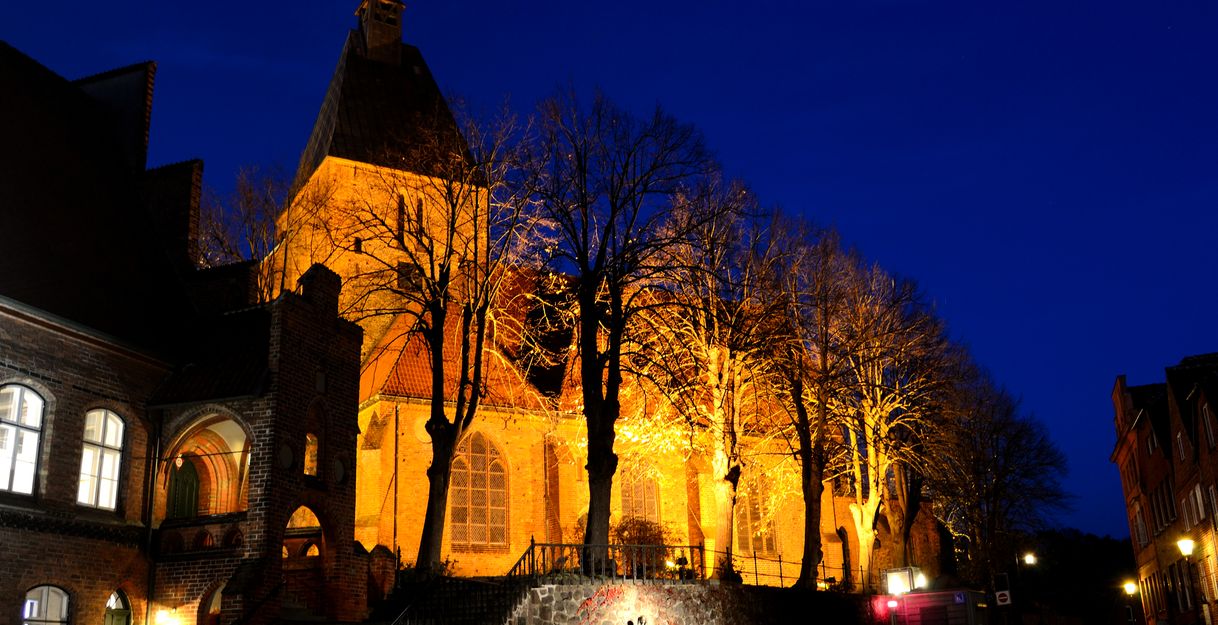
St. Nicolai Church Mölln
The only building from the founding period of the town of Mölln is the town church of St. Nicolai. It is dedicated to St. Nicolaus, the patron saint of merchants and sailors. Our recommendation: first take in the exterior view before entering the interior to experience a wealth of spectacular exhibits and ceiling and wall paintings.
Based on a document from 1217, the beginnings of construction of the church can be dated fairly reliably to around 1210. The brick building with clear Romanesque features was built in the following stages:
- The choir room was built first,
- then the tower in the west.
- In the third construction phase, the first bay of the nave was built as a connection to the tower.
- The second bay then connected to the choir.
- Around 1250, the construction of the basilica with the choir and the nave with two aisles was completed in its original form.
About 200 years later, in the late 15th century, the church building was extended. High Gothic halls with three bays now stand where the southern aisle used to be. At the same time, the apse - the semicircular part of the building was raised and Gothic windows were added. Finally, in 1497, the baptistery and the sacristy were added to the east.
As the name suggests, the church is dedicated to St. Nicholas, the patron saint of merchants and sailors. The second patron of the church is St. Jacob, the patron of pilgrims and wanderers. When you reach the north side of the nave during a tour, you will learn more about the two saints. For here they are part of the 13th century wall paintings. On the left is a Jacobus legend: Jacobus crowning a pair of pilgrims here. On the right side are St. Nicholas as a rescuer from distress at sea and the archangel Michael.
Take your time to experience true treasures from eight centuries of Christian life in Mölln. In the entrance area you will see the epitaph of the mayor Godeke Engels with the oldest view of Mölln from 1578. The strong fortifications of the "Fortress on the Salt Road" are clearly visible on it.
The shrine of the Virgin Mary on the right side at the entrance is probably a Lübeck work from the time around 1450. In the choir room you can see the Triumphal Cross from the workshop of the Lübeck carver Bernt Notke. The work was begun in 1503. The vines are supposed to remind of Christ's word of the vine. The symbols of the evangelists are depicted at the ends of the cross. The imposing baroque pulpit dates from 1742.
From the same era is the altar donated by the mayor Andreas Kahl in 1739, which rises above the Gothic mensa made of bricks. The altarpiece depicts the return of the prodigal son. The allegorical female figures on the left and right represent faith with Bible and chalice and hope with bird of paradise and anchor.
The oldest piece of decoration probably dates from the early days of St. Nicolai: a sandstone pedestal of Gothic origin from around 1200. It is probably the oldest stone sculpture in Lauenburg. The stone shows, among other things, motifs from the lives of the Magi. The Gothic altar shrine from the 15th century shows God with the body of Jesus on his lap, flanked by John and Matthew.
The seven-branched bronze chandelier from 1436 comes from the Marienwohlde monastery and was renovated in 1669, according to an inscription on the base. It was the property of the Stecknitzfahrer office and, according to oral tradition, was found by the Stecknitzfahrer in the Stecknitz canal.
The organ is a true rarity. Behind the baroque organ prospect from 1771, i.e. the front side of the organ, there is a remarkable instrument. For the sources mention an organ in the church of St. Nicolai for the first time already in the 15th century. In 1558, the important Hamburg organ builder Jacob Scherer was commissioned by the city's magistrate to build an organ in Mölln. What fascinates not only the historians is that despite numerous extensions, alterations and modifications, 162 pipes of the organ built by Scherer still exist.
The organists at St. Nicolai must have felt very much at home in Mölln. A look at their "gallery of ancestors" shows that the average tenure was almost thirty years. But none of them held office as long as Ludwig Hachmeister. He worked as church musician in Mölln from 1844 to 1902, i.e. 58 years. A window in the south nave commemorates him.
The bronze font, which is supported by three half-kneeling angels, was created in 1509 by the Lübeck foundryman Peter Wulf. The Annunciation chandelier in the south nave is also significant. At the corners are the figures of St. Catherine, St. Nicholas, St. Augustine and St. Ansverus. The chandelier was donated in 1506 by the office of the blacksmiths.
Also worth noting are the chairs and seats of the church. You will find, for example, the chair of the weavers from around 1600 and the Stecknitzfahrerstuhl from 1576. A special feature of the Möllner church are the communion boards. These are narrow wooden tablets on which the annual number of communion participants is recorded.
